
Anúncios
What if the way you study today is the reason you feel burned out tomorrow?
You can switch to a short, intense plan that beats marathon sessions and passive rereading.
Top students trade long nights for spaced reviews, quick retrieval practice, and timed mock exams. That shift helps them hold more information and feel calmer before tests.
In this guide you’ll see a simple weekly cadence that maps your goals to realistic study blocks. Small, doable steps—one retrieval round or one spaced review—build steady progress.
Expect practical techniques that
reduce stress, sharpen understanding, and make exam prep feel like a clear, doable way forward.
What top students really do differently to learn efficiently
The students who score best treat study time as practice, not review.
Rereading fades fast. You remember less when you only skim notes. Top students build meaning by making connections, generating examples, and testing themselves. That shift turns passive inputs into lasting memory.
Active learning over rereading: why “doing” beats “reviewing”
You stop rereading and start doing the work of learning. Create your own questions, explain ideas in your own words, and tie new information to what you already know.
The backbone: retrieval practice plus spaced practice
Two pillars change the game: self-testing and distributed review across days. Short, intense study blocks combined with planned spacing help your effort compound instead of evaporating overnight.
- Create quick topic guides and quiz yourself to make each block measurable.
- Use concept maps and teach aloud to expose gaps and fix confusion.
- Preview before class, review after, and space sessions across the week for steady progress.
Make it a simple process: turn lectures into questions, answer them later without notes, and repeat daily. Those small tips become a reliable study technique you can keep using.
Set the stage: prepare your brain and space for effective study
Start by arranging small, repeatable habits that let your brain do the heavy work. When your environment, sleep, and routine are ready, a short study block becomes far more productive.
Sleep, timing, and studying before bed
Stacking good sleep across several nights helps your grades and memory more than one long night does. Do a light review before bed and a quick check in the morning to lock in information without extra grind.
Pick the time of day when your attention is strongest and plan around it—morning or evening, whatever works best for you.
Switching locations and using sound wisely to help focus
Changing locations can cue recall and refresh attention. Still, keep one reliable spot for high-pressure sessions when you need predictable focus.
Test sound: quiet, instrumental, or lo-fi may help focus. Songs with lyrics often add distractions, so choose what actually helps you concentrate.
Fuel and movement: smart snacks and pre-study exercise
Move first—take a brisk 20-minute walk or do a short circuit to lift mood and prime the brain. Then study with steady-energy snacks like nuts, apples, or edamame and a glass of water.
- Protect your brain by stacking sleep and using brief reviews around bedtime.
- Silence notifications and park your phone away to cut distractions.
- Keep notes visible and simple so you start fast and reduce friction to action.
Quick tip: try one of these techniques for a week and note which helps focus most for your day.
efficient learning method: a simple step-by-step you can follow today
Start each topic with a quick scan and clear questions so your brain knows what to hunt for.
Preview and question: Use SQ3R or PQ4R to prime your attention. Survey headings, turn them into questions, read for answers, recite in your own words, and finish with a review. PQ4R adds a short reflection step that helps link ideas.
Study in short, intense sessions: Run 30–45 minute sprints with one clear objective. Set a single timer, work actively with self-testing, then take a short break to recharge. These study sessions outperform drawn-out time at a desk.
Close the loop: Mix reading, listening, and practice problems so the process hits information from multiple angles. Do a fast review after class, one day later, and again within the week to make sure gains stick.
- Capture unanswered questions and resolve them next session.
- Keep one source open, one outcome defined, one timer running.
- Finish with a two-sentence summary and mark the session on a visible checklist.
Turn questions into memory: retrieval practice that sticks
Make your study blocks active by forcing recall before you check your sources.
Retrieval practice beats looking things up. Start each block by writing what you remember on paper. That quick write anchors facts and shows what to fix next.
Write-to-recall: answer questions before peeking at notes
Convert headings into a short list of questions and answer questions on a blank page. Commit to an answer, then check notes. Writing forces deeper thinking and helps you remember information longer.
Create and trade questions to identify areas to improve
Make five mini practice items—mix fill-in-the-blank and “explain why” prompts. Swap tests with a classmate to surface gaps in your knowledge and to identify areas to review.
- Score each item: correct, partial, miss—review only the misses.
- Space short retrieval bursts across the week instead of cramming for one test.
- Keep it simple: a notebook, a pen, and one five-item quiz you can do anywhere.
Treat wrong answers as guidance, not failure. They point straight to what to fix in the next session. This lightweight study technique helps you remember information with less total time.
Make spaced practice automatic with the Leitner system
Turn simple flashcards into a daily engine that nudges tough facts forward and lets easier items rest. The Leitner system uses five boxes to schedule reviews so you spend more time on what you almost forgot.
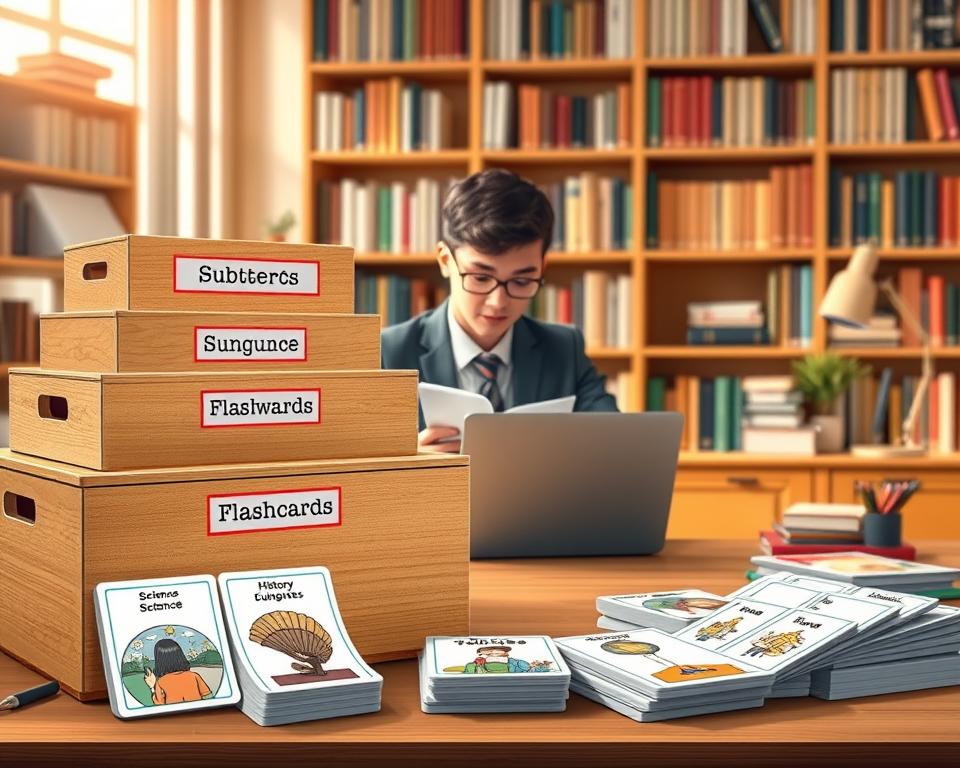
- Start all flashcards in Box 1. Keep each card to one idea: a concise prompt and a short answer.
- Move a card up a box when you answer correctly; move misses back to Box 1. This gives weak information more practice.
- Follow a simple cadence: Box 1 daily, Box 2 every two days, Box 3 every four days, Box 4 every nine days, Box 5 every 14 days.
Review only the boxes scheduled for that day to keep study sessions short and manageable. Batch-create cards right after class so content stays fresh, and write prompts that force recall — not recognition.
Why it works: spacing makes your brain work harder as memory fades, so you retain information with less total time. Track streaks for tough cards and celebrate small wins to keep momentum across the term.
Notes that teach you back: dual coding, color, and mind mapping
Clear, visual notes help you teach a topic back to yourself in minutes. Use color, maps, and paired visuals so each page becomes a mini-lesson you can quiz from quickly.
Color-code to spotlight ideas and topics. Use red for must-know items and yellow for high-value details. Standardize colors by category—definitions, processes, exceptions—so your eyes find what matters during a fast review.
Mind maps to show connections
Create a central node for the main concept and add branches for topics and sub-ideas. This layout mirrors how your brain stores information and makes connections visible at a glance.
Dual coding: pair words with visuals
Pair short phrases with arrows, timelines, or labeled diagrams. Two channels—words plus images—give your memory two ways to access the same content. For a quick primer, see the dual coding guide.
- Keep each page to one example or concept to avoid clutter.
- Write a short, plain-English note beneath charts to boost understanding.
- Refine notes after retrieval practice to close gaps and guide your next study block.
Manage time like a pro: the Study Cycle and weekly planning
Plan the week once, then protect short study windows so progress becomes automatic.
The Study Cycle gives a simple process you can repeat every class. Preview before class, attend actively, review soon after, study in focused blocks, and check understanding at the end.
Use the Study Cycle to structure study sessions and reviews
Run the cycle for every topic. A quick preview primes your brain. Active attendance fills gaps. Then do a short review the same day to lock basics.
Space follow-ups across several days of the week rather than one long push. Short touches each day build retention and cut late-night crams.
Calendar tactics to protect your hours and goals
Pick one day each week to plan. List tasks by course, estimate available hours, and place blocks on your calendar so the time is protected.
- Assign one objective per block, for example: “quiz Chapter 3 problems 1–10.”
- Triage materials—read the main source closely and skim supplements so you make sure high-impact work gets done.
- Keep buffer time for life’s surprises and fill small gaps with light tasks like card reviews.
- Track progress weekly against your goals and tweak next week’s plan based on what worked.
Stack retrieval and spacing inside your scheduled blocks so technique meets time management. For a template to build a productive routine, see a simple productive study schedule.
Cut distractions, boost focus: design study sessions that work
The way you set up a session often decides how much information you actually keep. Start by removing anything that invites multitasking so your brain can do its job.
Turn the phone off or leave it in another room, use site blockers, and schedule short social breaks so you don’t feel deprived. Multitasking slows you and increases the total time needed to learn.
- Set a clear start and end time with a timer so each block stays focused.
- Decide the noise that helps your brain—quiet, light café buzz, or instrumental tracks.
- Keep only the materials for this block on your desk to reduce visual clutter.
- Speak key steps or definitions aloud; active study is often not silent.
- Make sure each session has one outcome so you leave with usable information.
Swap locations when a spot loses its edge and reward focused work with a timed check-in on messages. These simple techniques protect attention and help focus during study sessions.
Go deeper: Feynman Technique, elaboration, interleaving, and examples
Use plain words and varied practice to turn facts into flexible knowledge you can use on demand. The deep work here tests your understanding by forcing you to explain, connect, and apply ideas rather than just recall them.
Teach it simply: the Feynman Technique to test understanding
Write the topic at the top of the page, then explain it like you would to a beginner. This exposes gaps fast. Rewrite unclear parts in plainer words until the concept is tight and clear.
Elaborative interrogation: ask “why” to build connections
Generate “why” questions for each fact and answer them with background details. That process links new knowledge to things you already know and strengthens mental connections.
Interleaving related topics to strengthen problem solving
Mix practice across related topics—A, B, then A again—instead of doing long blocks of one subject. This trains flexible thinking and helps you recognize patterns between topics.
Concrete examples to anchor abstract information
Attach every abstract concept to at least one vivid example you can picture. Examples give your brain a retrieval hook when recall gets fuzzy.
- Run the Feynman loop: topic → simple explanation → find gaps → refine.
- Ask short, targeted questions to reveal hidden assumptions and build connections.
- Rotate these techniques across the week and finish each deep-dive with a one-minute summary: main point, one connection, one example.
Practice tests and feedback: simulate the test to build confidence
Timed practice tests let you measure speed, spot weak spots, and calm test-day nerves.
Run full-length exams under real timing and without notes. This mirrors the conditions you’ll face and highlights pacing issues you won’t see during untimed study.
Mock exams to reduce stress and refine techniques
Schedule two or more full exams across the term and shorter section tests in between. Treat these sessions like training: set the clock, find a quiet spot, and record your start and end times.
Analyze misses and update your materials and process
Review every question—right or wrong—and log patterns in an error journal. Tag each miss: concept gap, careless slip, or misread question. Then rewrite weak notes and update study materials to fix root causes.
- Simulate exam conditions to find pacing tweaks before test day.
- Redo missed items from memory, then space a re-quiz days later to retain information.
- Block dedicated hours each week for retrieval and practice testing; treat them as non-negotiable.
Keep the goal practical: clarity about the next action beats perfect scores on the first try. This is the way students turn tests into reliable feedback, not just a final verdict.
Conclusion
Short, focused actions each day stack up into real progress across weeks.
Keep it simple, and protect your brain with sleep, movement, and no multitasking. Use the Study Cycle to preview, attend, review, study, and check so each session builds on the last.
Anchor new information with spaced practice, quick retrieval, color-coded notes, and Leitner cards. Run mock exams, fix misses, and finish every block by answering flagged questions in your own words.
Treat this as a flexible playbook: track what works, tweak your approach, and let small daily habits turn topics and notes into lasting knowledge you can actually use.